Key Takeaways:
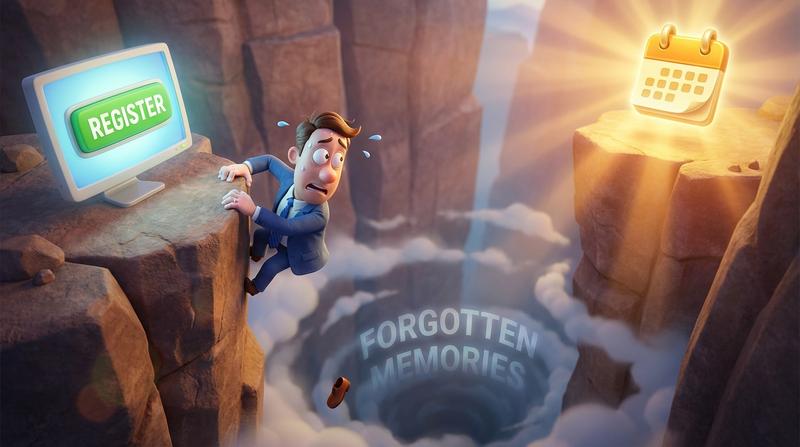
- Registration is not commitment - there's a massive psychological canyon between signing up and showing up
- The forgetting curve works against you: people forget up to half of new information within days without reinforcement
- Calendar saves trigger the endowment effect - once something is in YOUR calendar, it feels like YOUR decision
- The 48-72 hour post-registration window is where most attendee momentum dies
- Calendar save rate is your new north star metric for predicting actual attendance
Here's a stat that should make every event organizer uncomfortable: most of your registrants won't show up.
You can have a killer landing page. A persuasive email sequence. Even a waitlist that builds FOMO. But between the moment someone clicks "Register" and the moment they actually walk through your door (or join your Zoom) - there's a psychological canyon that swallows attendance rates whole.
Most event marketers obsess over registration numbers. They celebrate every signup. They report those numbers to stakeholders like they've already won.
But here's the uncomfortable truth: registration is not commitment. It's barely even interest.
The real commitment? It lives in the calendar. And if you're not engineering that moment, you're leaving attendance - and revenue - on the table. 🎯
The Commitment Gap Nobody Talks About
Let's get something straight: someone filling out your registration form is not the same as someone planning to attend.
Psychologically, these are completley different actions.
Registration = intention. It's easy. It's low-stakes. It costs nothing but 30 seconds and an email address.
Attendance = action. It requires blocking time, showing up, and following through on a decision made days or weeks ago.
The gap between these two? That's where your no-shows live.
The Forgetting Curve Hits Harder Than You Think 😓
Hermann Ebbinghaus figured this out back in 1885 - and modern attention spans have only made it worse. According to his research on the forgetting curve, humans tend to forget up to half of newly learned information within just days or weeks unless it's actively reinforced.
Think about that in the context of your event.
Someone registers on Monday. By Thursday, they've:
- Received 200+ emails
- Attended three meetings
- Scrolled through countless social posts
- Made a dozen other micro-decisions
Your event? It's buried. Not because they don't care - because that's just how memory works.
The Science of Micro-Commitments
So how do you bridge the commitment gap?
You make people take one more small action. And then that action does the heavy lifting for you.
This is behavioral psychology 101 - specifically, the foot-in-the-door effect.
The Foot-in-the-Door Effect
The classic 1966 study by Freedman and Fraser demonstrated something remarkable: when residents first agreed to display a small "Drive Carefully" sign, 76% later agreed to put up a much larger sign. Compare that to only 17% compliance when asked directly for the big commitment.
The principle? Small agreements create psychological momentum for larger ones.
When someone saves your event to their calendar, they're not just adding a reminder. They're:
- Taking an active step (not passive)
- Making a visible commitment
- Adjusting their self-perception ("I'm someone who attends this type of event")
How Calendar Saves Trigger Ownership Bias
Here's where it gets really interesting.
The endowment effect - also called ownership bias - shows that people value things more once they own them. In behavioral economics experiments, people consistently demand more to give up something they have than they'd pay to acquire it in the first place.
What does this have to do with calendars?
Everything.
When your event exists in someone's personal calendar, it becomes their event. Their decision. Their commitment.
That calendar entry isn't just data - it's psychological real estate. And calendar saves create psychological ownership in ways that email confirmations simply can't match.
Where Most Event Funnels Break
Let's talk about the dead zone - that dangerous stretch between signup and showup where most of your attendees quietly disappear.
The Typical Post-Registration Experience
- Registrant signs up → Feels good about the decision
- Confirmation email arrives → Gets glanced at, maybe archived
- Days pass → Life happens
- Reminder email sent → Buried in inbox, possibly unopened
- Event day arrives → "Wait, that was today?"
Sound familiar?
The 48-72 Hour Problem
Research shows that the critical 48-72 hour window where momentum dies is when most drop-off occurs. The initial excitement fades. The forgeting curve kicks in. And your event loses its mental priority.
Here's the thing: reminders alone don't fix this problem.
Why? Because reminders are passive. They arrive in an inbox that's already overflowing. They compete with everything else demanding attention.
You can't remind someone into commitment. You have to engineer the commitment upfront.
The Calendar as Commitment Device
As the legendary psychologist Robert Cialdini said:
"People will do almost anything to remain consistent with their own prior actions and statements."
This is exactly why the calendar is so powerful.
Why Personal Calendars Change Behavior
Your calendar isn't like your email inbox. It's not a dumping ground for other people's priorities.
Your calendar is your space. Your plans. Your decisions.
When something appears there, it carries weight:
| Email Confirmation | Calendar Entry |
|---|---|
| External communication | Personal planning |
| Passive receipt | Active commitment |
| Easily buried/deleted | Visible time block |
| Competes with 100+ daily emails | Survives inbox chaos |
| "Someone sent me this" | "I decided to do this" |
The Visual Real Estate Effect
There's another factor at play: blocking time creates obligation.
When your event occupies a visual slot in someone's week, it's no longer an abstract possibility. It's a concrete commitment. They can see it. They have to plan around it. Other activities get scheduled around your event - not the other way around.
This is the difference between passive interest and active commitment.
Making the Save Frictionless 💡
So if calendar saves are this powerful, why isn't everyone doing it right?
Because the technical reality is... messy.
The Broken Link Problem
Here's what typically happens:
- Event organizer adds a generic "Add to Calendar" link
- Link only works for one calendar type (Google users? Great. Apple users? Sorry.)
- Link breaks on mobile devices
- Timezone handling goes haywire for remote attendees
- The friction causes abandonment
And just like that - all your psychology work gets undone by bad technology.
"A user interface is like a joke. If you have to explain it, it's not that good." - Martin LeBlanc
The same applies to calendar integration. If it requires extra steps, explanations, or troubleshooting - you've already lost.
Add to Calendar PRO: The Bridge Between Intention and Action
This is exactly where Add to Calendar PRO comes in.
Instead of cobbling together fragile calendar links that break across devices and platforms, you get:
- One-click saves that work across Google, Apple, Outlook, and more
- Automatic timezone handling so remote attendees don't miss your event
- Mobile-optimized experiences that don't frustrate users on the go
- Dynamic updates when event details change
The psychology only works if the technology doesn't get in the way. Add to Calendar PRO turns one click into locked-in commitment - no friction, no frustration, no drop-off.
Measuring What Actually Matters
It's time to rethink your metrics.
Beyond Registration Numbers
Most event marketers track:
- Registration count
- Email open rates
- Email click-through rates
But here's the problem with these metrics: they're vanity numbers. They measure activity, not commitment.
Email opens don't predict attendance. Neither do clicks. You can have stellar email engagement and still see 50%+ no-show rates.
Calendar Save Rate: Your New North Star 🚀
The metric that actually predicts attendance? Calendar save rate.
When you track calendar saves as your new leading indicator, you're measuring real commitment - not just passive interest.
| Metric | What It Measures | Predictive Value |
|---|---|---|
| Registrations | Initial interest | Low |
| Email opens | Inbox behavior | Low |
| Email clicks | Curiosity | Medium |
| Calendar saves | Active commitment | High |
This shifts everything:
- You can segment attendees by commitment level
- You can forecast actual attendance more accurately
- You can identify where your funnel is leaking
- You can optimize for the metric that actually matters
Conclusion: Stop Celebrating Registrations, Start Engineering Commitment
The registration is not the finish line. It's barely the starting gate.
If you want to actually improve attendance - not just registration numbers - you need to engineer the commitment moment. And that moment lives in the calendar.
Here's your action plan:
- Audit your current flow - What happens after someone registers? Is there a calendar save option? Does it actually work?
- Eliminate friction - Test your calendar links on every device and platform. One broken experience costs you attendees.
- Track calendar save rate - Make this your new leading indicator. It's far more predictive than email metrics.
- Implement proper tooling - Add to Calendar PRO handles the technical complexity so you can focus on the psychology.
The forgetting curve is working against you. Inbox chaos is working against you. Short attention spans are working against you.
But behavioral psychology? That can work for you.
The calendar save is your final conversion point - the moment where passive interest transforms into active commitment. Every attendee who saves your event has taken a micro-action that reshapes their self-perception and creates psychological momentum.
Stop celebrating registrations.
Start engineering commitment. 🎯