Key Takeaways:
- Free events experience 40-60% no-show rates - and most of that loss happens in the first 48 hours after registration
- The Ebbinghaus forgetting curve shows people lose most newly learned information within 24-48 hours without reinforcement
- Email confirmations have a 42% average open rate - meaning most of your registrants never see your reminder
- Calendar placement creates psychological micro-commitments that email simply cannot replicate
- Your new north star metric should be "calendar save rate," not registration numbers
Here's a truth that stings: That registration spike you're celebrating right now? About half those people won't show up.
I know. You worked hard for those sign-ups. The landing page. The social posts. The email sequences. You watched the numbers climb and felt that dopamine hit every time a new name appeared in your dashboard.
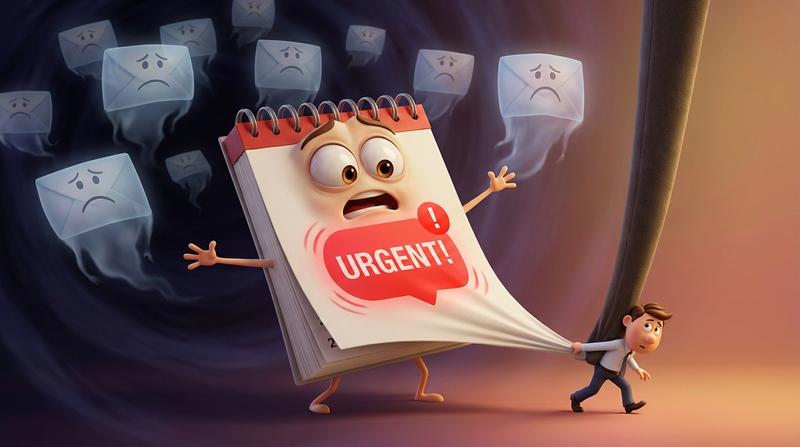
But here's the deal: there's a 48-hour window immediately after someone registers where you either lock in their commitment - or lose them forever.
And most event organizers? They're losing.
The Registration High vs. Attendance Reality
Let's talk about that beautiful moment when someone clicks "Register."
They're excited. They're interested. They genuinely intend to attend your event.
Then... silence.
You send a confirmation email. Maybe they open it. Probably they don't. Life moves on. Your event gets buried under 47 other emails, 12 Slack notifications, and whatever Netflix released this week.
According to industry research, free in-person events typically experience 40-60% no-show rates. Even paid events see 10-30% of registrants vanish into thin air.
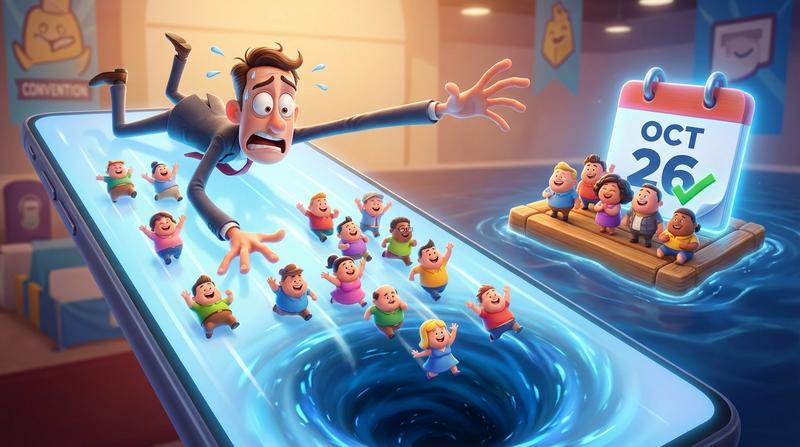
That's not a leak in your funnel. That's a waterfall. 💔
The Psychology of Forgetting: Why Registrations Don't Equal Butts in Seats
Here's where psychology gets uncomfortable.
In the 1880s, German psychologist Hermann Ebbinghaus discovered something that should terrify every event organizer: people forget a large portion of newly learned information within the first 24 to 48 hours.
This is called the forgetting curve, and it's brutally predictable. Memory loss is steepest right after learning something new - then tapers off over days and weeks.
Applied to your event?
That registration confirmation your attendee received? It's already fading from memory before they finish their morning coffee.
The Email Confirmation Problem
Your confirmation email faces some harsh math:
- Global average email open rate: 42.35%
- That means 57.65% of your confirmations are never even opened
- Of those who open? Most skim, close, and move on
- That email gets buried - forever
There's a massive mental difference between "I signed up for something" and "It's in my calendar." One is a vague intention floating in memory. The other is a visual commitment staring back at them every single day.
The Commitment Gap: Registration Excitement vs. Day-Of Reality
"The best time to plant a tree was 20 years ago. The second best time is now." - Chinese Proverb
The same logic applies to attendee commitment. The best time to lock in that commitment? Immediately after registration. Not tomorrow. Not with your reminder email three days before. Right now.
Because here's what happens in the meantime:
- Life happens. Kids get sick. Work deadlines shift. That "free afternoon" suddenly isn't free anymore.
- Intent decays. That enthusiasm from registration? It has a half-life of about 48 hours.
- Competition appears. Your event isn't just competing with other events - it's competing with everything. Netflix. Errands. The sudden urge to reorganize the garage.
Without reinforcement, your event becomes just another thing they "meant to do."
Why Calendar Placement Changes Everything
Let's compare two scenarios:
| Scenario | What Happens | Day-Of Result |
|---|---|---|
| Email Only | Confirmation sent → opened once (maybe) → buried in inbox → forgotten | "Wait, that was today?" 😬 |
| Calendar Saved | Event appears in daily view → phone notification fires → visual reminder every time they check schedule | "Oh right, I have that thing at 2pm" ✅ |
The psychology here is simple but powerful.
When someone adds your event to their calendar, they're not just storing information. They're making a micro-commitment. They're telling themselves (and their calendar) that this time is spoken for.
Research shows that calendar saves increase event engagement by 86% compared to email reminders alone. That's not a marginal improvement - that's a transformation.
The Visual Reminder Advantage
Calendar entries fire reminders at the right moments:
- The night before: "Tomorrow: Marketing Workshop at 2pm" - gives them time to plan
- The morning of: Appears in their daily agenda - mental preparation kicks in
- One hour before: Final nudge - they start wrapping up other tasks
Email can't do this. Email sits passively in an inbox, hoping to be noticed. Calendar entries are active. They interrupt. They demand attention.
And that interruption? It's exactly what you need.
Closing the 48-Hour Window: A Practical Framework
Okay, enough about the problem. Let's fix it. 🛠️
Step 1: Capture Commitment Immediately Post-Registration
The moment someone registers, your confirmation page should do one thing above all else: get them to save the event to their calendar.
Not buried at the bottom. Not as an afterthought. Front and center.
This is the psychological sweet spot. They're still excited. They're still engaged. Their intent is at peak strength.
Step 2: Make the Calendar Save Frictionless
Here's where most organizers fail.
They add a calendar link that:
- Only works for Google Calendar (sorry, Apple and Outlook users)
- Downloads a confusing .ics file that opens in the wrong app
- Breaks on mobile devices
- Shows the wrong timezone
Every friction point loses attendees. Every extra click is an exit opportunity.
You need calendar email links that actually work - across every platform, every device, every timezone.
Step 3: Turn Registration Pages into Commitment Engines
This is where Add to Calendar PRO transforms your entire approach.
Instead of hoping people manually add your event (spoiler: they won't), you embed a button that:
- Works with Google, Apple, Outlook, Yahoo, and .ics files - one click
- Handles timezone conversion automatically
- Functions perfectly on mobile and desktop
- Updates attendees if event details change
The result? Your registration page stops being an endpoint and becomes a conversion point - where casual interest transforms into genuine commitment.
Measuring What Matters: Beyond Registration Numbers
"What gets measured gets managed." - Peter Drucker
Most event organizers obsess over the wrong metric. They celebrate registration numbers while ignoring the metric that actually predicts attendance.
Your New North Star: Calendar Save Rate
Start tracking this:
Calendar Save Rate = (Calendar Saves ÷ Registrations) × 100
A healthy rate? Aim for 60%+ initially. World-class events hit 80%+.
Here's why this matters:
| Metric | What It Tells You |
|---|---|
| Registration Count | Interest level (unreliable predictor of attendance) |
| Email Open Rate | Whether your message was seen (not whether they'll show) |
| Calendar Save Rate | Actual psychological commitment (strong predictor of attendance) |
Correlating Saves to Attendance
Once you track calendar saves alongside actual attendance, patterns emerge:
- People who save to calendar show up at dramatically higher rates
- No calendar save = high no-show probability
- You can identify at-risk registrants before the event and re-engage them
This is the data that predicts no-shows before they happen. And prediction means you can actually do something about it.
The Shift From 'Signed Up' to 'Showing Up'
Let me be direct: stop celebrating registrations.
Registrations are vanity metrics. They make you feel good. They look impressive in reports. But they don't put people in seats.
The mindset shift you need?
- Old thinking: "We got 500 registrations! 🎉"
- New thinking: "We got 500 registrations. 340 saved to calendar. We need to re-engage those other 160."
This is what separates amateur event marketing from professional attendance engineering.
You can even share calendar events like social posts - turning attendees into advocates who spread your event to their networks.
Conclusion: Engineer Attendance, Don't Just Hope For It
That 48-hour window after registration? It's not a threat - it's an opportunity.
It's the moment when you can transform fleeting interest into locked-in commitment. When you can move from the chaos of email inboxes to the prime real estate of someone's calendar.
The tools exist. The psychology is clear. The data backs it up.
Add to Calendar PRO turns this entire framework into a simple reality: one button, universal compatibility, and the peace of mind that comes from knowing your registrants aren't just signed up - they're showing up.
Because at the end of the day, empty chairs don't care how many people registered.
Ready to close your 48-hour window? Stop losing attendees to forgetfulness and start engineering the attendance your events deserve.