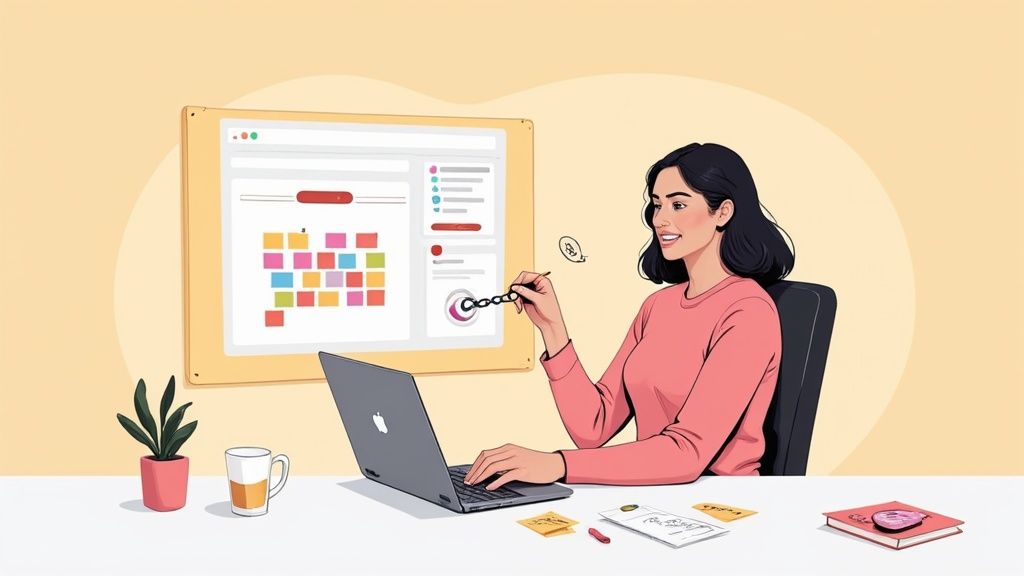
Most brands are fighting a losing battle. They're pouring money into email campaigns and social feeds while completely ignoring the one place their audience checks 10+ times every single day.
Their calendar.
Key Takeaways:
- Email open rates are inflated by privacy features, and organic social reach hovers around 5% - meanwhile, calendar entries enjoy 100% visibility
- When you share calendar events strategically, you're not sending reminders - you're claiming persistent marketing real estate
- The shift from "send invite" to "occupy space" transforms one-off notifications into lifecycle touchpoints
- Smart calendar sharing requires infrastructure that handles dynamic events that update automatically without maintenance headaches
- Brands winning attention in 2025 aren't louder - they're simply more present
📅 The Calendar as a Marketing Channel: Why It Deserves Its Own Strategy
Here's the deal: marketers obsess over channels that actively work against them.
Email? According to MailerLite's 2025 benchmarks, the average open rate sits at 43.46%. Sounds decent, right? But there's a massive catch - Apple Mail Privacy Protection automatically marks emails as opened, artificially inflating those numbers. Real engagement? Much lower. Click-through rates hover around just 2%.
Social media? It's become pure pay-to-play. Organic posts now reach roughly 5% of your followers. That's it. You have zero control over visibility unless you're paying.
But calendar entries? They have 100% visibility.
Think about it. When someone adds your event to their calendar, it doesn't compete with 47 other brand messages. It doesn't get buried. It doesn't vanish into an algorithmic void.
It sits there. Waiting. Reminding. Present.
As Seth Godin once said, "Marketing is no longer about the stuff that you make, but about the stories you tell." When you share calendar events, you're not just telling a story - you're writing yourself into someone's day. Literally.
The Psychology of Calendar Commitment
Here's what makes this channel different:
- Calendar items feel like personal commitments, not brand intrusions
- They trigger at the perfect moment - when the user is planning their time
- The act of saving an event creates psychological ownership
- Reminders feel helpful, not spammy
This is calendar marketing software thinking at its finest. You're not interrupting - you're becoming part of someone's schedule.
🔄 Share Calendar vs. Share Link: The Critical Mindset Shift
Most marketers think transactionally. Send invite. Hope they show up. Done.
But smart ones? They think territorially. They understand that when you share calendar events, you're not just booking a slot - you're occupying mental real estate over time.
| Old Way (Transactional) | New Way (Strategic) |
|---|---|
| Send single event invite | Claim lifecycle touchpoints |
| "Remind them once" | "Stay present for weeks" |
| Calendar = utility | Calendar = marketing channel |
| Hope for attendance | Engineer engagement |
| One-click, done | Pre-event, day-of, follow-up |
| Static details | Dynamic, updating content |
See the difference?
A social post disappears from feeds within hours. An email gets buried in minutes (if it even gets opened). But a calendar entry? It stays for days. Weeks sometimes. And it keeps resurfacing through notifications and daily planning sessions.
Beyond the Single Event
When you shift your thinking, you start seeing opportunities everywhere:
- Pre-event hype - Get on calendars early, build anticipation
- Day-of reminders - Automatic visibility when it matters most
- Follow-up touchpoints - Post-event actions, feedback requests, next steps
- Recurring engagement - Monthly check-ins, seasonal campaigns, renewal dates
This isn't about one event. It's about lifecycle marketing through persistent presence.
🛠️ Building Your Calendar Sharing Strategy (Practical Framework)
Alright, so you're convinced. Calendar = underutilized channel. Now what?
Here's how to actually build a strategy around it.
Step 1: Identify Calendar-Worthy Moments
Not everything belongs on someone's calendar. But these moments absolutely do:
- Product launches and drops - Build anticipation, reduce FOMO
- Webinars and live events - Obviously
- Subscription renewals - Reduce churn with timely reminders
- Customer milestones - Anniversary dates, achievement unlocks
- Sales and promotions - Limited-time offers that benefit from countdown psychology
- Content releases - Podcast episodes, course modules, newsletter specials
Ask yourself: "Would my customer want to remember this?" If yes, it's calendar-worthy.
Step 2: Make Sharing Absolutely Frictionless
Here's where most strategies fall apart.
You've got the perfect moment. The user is interested. They're ready to save it. And then... you give them a confusing download link. Or an .ics file that opens in a weird app. Or instructions that require six clicks.
Game over.
One-click saving to any calendar app isn't a nice-to-have. It's the whole ballgame.
Step 3: Keep Events Dynamic
Plans change. (Shocker, I know.)
Venue moves. Time shifts. Speaker cancels. Details evolve.
If you're sharing static calendar files, you're creating a support nightmare. Users show up at the wrong place. They miss the rescheduled time. They blame you.
The solution? Dynamic events that update automatically. When details change on your end, they change on the user's calendar too. No stale info. No confusion. No angry customers.
💡 The Infrastructure Question: What You Actually Need
Let's get real for a second.
You can try to build this yourself. Generate .ics files manually. Handle timezone conversions (have you ever worked with timezones? Crazy thing...). Support every calendar platform. Update events without breaking syncs.
Or you can acknowledge that this is infrastructure work - and use tools built for exactly this purpose.
When you need to share calendar events at scale - across email campaigns, landing pages, QR codes, confirmation flows - you need a backend that just works.
Add to Calendar PRO provides exactly this infrastructure. It turns any touchpoint into a calendar placement opportunity:
- Works across Google Calendar, Apple, Outlook, Yahoo, and more
- Updates in real-time when details change
- Zero maintenance headaches on your end
- Calendar sharing at scale through automation integrations
The goal isn't to become a calendar technology company. It's to enable calendar marketing software capabilities without building everything from scratch.
ROI Comparison: Channels Side by Side
| Channel | Visibility | Lifespan | User Perception | Cost Trend |
|---|---|---|---|---|
| ~43% open (inflated) | Minutes to hours | "Another promo" | Rising | |
| Social (Organic) | ~5% reach | Hours | "Content I scroll past" | Declining value |
| Social (Paid) | Guaranteed | Hours to days | "Ads" | Rapidly rising |
| Calendar Events | 100% | Days to weeks | "My commitment" | Stable |
The math is pretty clear.
🎯 Making the Shift: From Afterthought to Channel
"The best marketing doesn't feel like marketing." - Tom Fishburne
Calendar marketing embodies this perfectly. When done right, it feels like a service. A helpful reminder. Something the user chose to keep.
But here's the thing - you can't treat it like an afterthought and expect results.
Start thinking about calendar sharing the way you think about email or social:
- Audit your customer journey for calendar-worthy moments
- Build frictionless save buttons into every relevant touchpoint
- Use dynamic events so you never send outdated information
- Track calendar saves as a conversion metric
- Iterate and optimize just like any other channel
The Bottom Line: Presence Beats Volume
The brands winning attention right now aren't the loudest ones.
They're the most present.
While competitors blast emails that get ignored and boost posts that disappear, smart marketers quietly claim space on calendars. They show up exactly when it matters - in the daily planning moment, in the morning review, in the afternoon schedule check.
No algorithm can bury you there.
No unsubscribe link removes you from someone's Tuesday.
No pay-to-play model throttles your visibility.
You're just... there. Present. Reminding. Converting.
Start treating calendar sharing as a channel, not an afterthought. Identify your key moments. Build frictionless save experiences. Keep events fresh with automatic updates.
And if you want the infrastructure to power this without building it yourself, explore how Add to Calendar PRO enables this new marketing layer.
Your competitors are still fighting for inbox scraps.
You could be claiming calendar real estate instead. 🚀