You check your calendar multiple times every single day. So does your audience. Yet most marketers completely ignore this channel while fighting tooth and nail for attention in crowded email inboxes and algorithmically-throttled social feeds.
That's about to change.
🔑 Key Takeaways
- Your audience's calendar is a marketing channel - one with 100% visibility and zero algorithmic interference
- Email open rates dropped to 35.6% in 2024, while calendar reminders reach users every single time
- Organic social reach has collapsed to under 8% on Instagram and 6% on Facebook - calendars don't have this problem
- Calendar presence creates persistent brand touchpoints without feeling intrusive or annoying
- The brands building calendar strategies today will dominate customer retention tomorrow
The Overlooked Channel Hiding in Plain Sight
Here's a contrarian thought: The most powerful marketing channel you're ignoring isn't some new social platform or AI tool. It's the calendar app your customers open 10+ times daily.
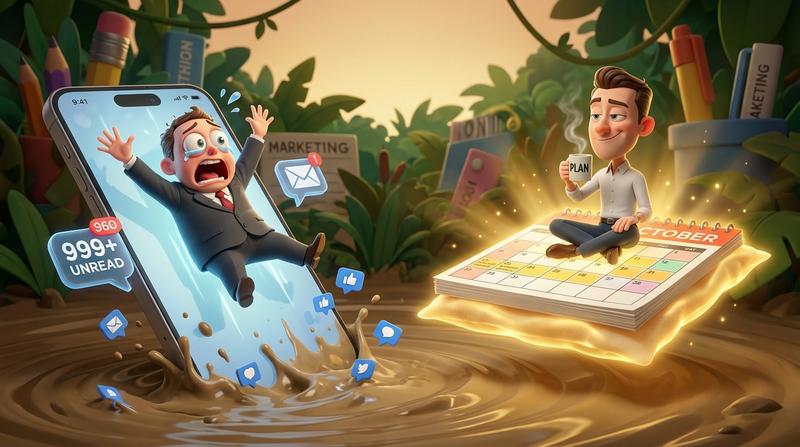
Think about it. Your audience treats their calendar like sacred ground. It's where they organize their lives, protect their time, and plan their futures. Email inboxes? Those are battlegrounds - cluttered with promotional noise, spam filters, and that constant anxiety of "unread" notifications.
But calendars? Calendars are quiet sanctuaries.
As Peter Drucker once said: "What gets scheduled gets done."
And yet... marketers spend millions optimizing email subject lines while completely ignoring the calendar channel. It's like owning beachfront property and never building on it.
Time to think like a calendar marketer.
🗓️ The Calendar as a Marketing Channel: Why It's Different
Let me be direct: Calendar marketing isn't just "another channel." It operates on completely different psychological principles than email or social.
Unlike Email, Calendar Entries Don't Compete - They Command
When your event lands in someone's calendar, it doesn't fight for attention against 47 other promotional messages. It simply... exists. Waiting for its moment.
No algorithm decides whether to show it. No spam filter threatens to bury it. No competitor can outbid you for that slot.
You own that moment.
The Psychology of "Saved Time" vs "Saved Email"
Here's something most marketers miss: When someone saves an event to their calendar, they're not just "bookmarking" information. They're making a psychological commitment.
Research shows why calendar saves increase engagement by 86% - and it comes down to ownership. A calendar entry represents protected time. It's a promise they've made to themselves.
An email confirmation? That's passive. It sits there, unopened, forgotten.
A calendar save? That's active planning behavior.
The Real Estate Metaphor (But Actually Accurate)
With email, you're essentially renting attention. You pay - with subject line optimization, send time testing, list management - and you get temporary visibility. Maybe.
With calendar marketing, you're not renting space. You're owning a moment in someone's life.
That's a fundamentally different value proposition.
📊 Calendar Marketing vs Traditional Channels: The Numbers
Let's talk data. Because the comparison between calendar marketing and traditional channels isn't even close.
The Email Reality Check
According to recent industry data, average email open rates fell to 35.6% in 2024 - down from 38.2% in 2023. That's a 2.6 percentage point decline year-over-year.
Translation: Nearly two-thirds of your emails never get opened. And that number keeps shrinking.
The Social Media Collapse
Organic reach on social platforms has cratered dramatically. Current 2025 statistics show:
- Instagram: ~7.6% organic reach per post (and declining 18% year-over-year)
- Facebook: ~5.9% organic reach (some studies show as low as 2.6%)
Your carefully crafted social content reaches fewer than 1 in 10 followers. Unless you pay, of course. (Funny how that works. 🤨)
Calendar Visibility: 100%
Now compare that to calendar entries.
Visibility rate? 100%.
Every single person who saves your event to their calendar will see it. Multiple times. With reminders. On the exact day and time it matters.
| Channel | Visibility Rate | Algorithmic Control | Competitor Interference |
|---|---|---|---|
| 35.6% open rate | Spam filters, tabs | Inbox clutter | |
| 5.9% reach | Heavy algorithm | Pay-to-play | |
| 7.6% reach | Heavy algorithm | Content saturation | |
| Calendar | 100% visibility | None | Zero |
The "show rate" gap between email confirmations and calendar saves is massive. Smart marketers understand how smart marketers share calendar events like social posts - and why that approach consistently outperforms traditional channels.
🧠 Building Your Calendar Marketing Strategy
Okay, so calendars are powerful. But how do you actually build a strategy around this channel?
Here's the framework:
Step 1: Identify Calendar-Worthy Moments
Not everything belongs on a calendar. You need to identify moments in your customer journey that genuinely deserve protected time.
Ask yourself:
- When does my customer need to show up somewhere (physically or digitally)?
- What deadlines matter to them?
- What recurring touchpoints would they actually want reminders for?
Good calendar candidates include:
- Live events and webinars
- Product launches and early access windows
- Subscription renewals or billing dates
- Seasonal sales or limited-time offers
- Course sessions or training modules
- Consultation appointments
Step 2: Make the Save Frictionless
Here's the deal: This is where most brands completely fail.
They identify great calendar moments... then make saving them impossibly complicated. Confusing buttons. Broken .ics files. Timezone nightmares. (Have you ever worked with timezones? Crazy thing...)
Every extra click, every moment of confusion - that's a lost calendar placement.
The save experience needs to be as easy as breathing. One click. Works everywhere. No downloads. No confusion.
This is where Add to Calendar PRO becomes essential infrastructure. It handles the technical complexity - multiple calendar platforms, timezone localization, mobile compatibility - so your users just see a seamless "Add to Calendar" experience.
Step 3: Own the Reminder Cycle
Here's something beautiful about calendar marketing: One action from your user creates multiple touchpoints.
They save once. Then they see your event:
- When they review their week on Sunday
- When they check tomorrow's schedule
- When the first reminder fires (maybe 24 hours before)
- When the second reminder fires (maybe 1 hour before)
- At the actual moment of the event
That's 5+ brand impressions from a single calendar save. No additional cost. No additional effort.
"The best marketing doesn't feel like marketing." - Tom Fishburne
Calendar reminders feel helpful, not promotional. That's the magic.
🚀 Beyond Events: Creative Calendar Marketing Plays
Most marketers think calendar = events. But the channel is way more versatile than that.
Product Launches & Seasonal Campaigns
That product drop next month? Don't just announce it on social (where 93% of followers won't see it). Give people a calendar save option.
Now they have a reminder set for launch day. They'll remember. They'll show up.
Subscription Renewals
Instead of surprising customers with a renewal charge - and triggering cancellation reflexes - offer a calendar reminder a week before. "Your subscription renews in 7 days."
Transparent. Helpful. Retention-positive.
Turning Webinars Into Recurring Series
Single webinars are fine. But the real power comes from recurring calendar series.
Imagine your audience has "Marketing Masterclass - Every Tuesday at 2pm" built into their weekly rhythm. That's not just attendance - that's habit formation.
The "Calendar Drip" Concept
This is where things get interesting.
You know email drip campaigns? Same concept, but for calendars.
A new customer signs up. Instead of (or alongside) email sequences, they get strategic calendar placements:
- Day 3: "Complete your profile setup" reminder
- Day 7: "Your first weekly tips session" event
- Day 14: "Check out advanced features" prompt
- Day 30: "Renewal coming up" heads-up
This is lifecycle marketing through calendar presence. And it works beautifully for education platforms - see how calendar drip campaigns for lifecycle marketing can save 15-20 hours per cohort while improving completion rates.
💡 The Infrastructure Layer
Now, I'll be honest: Building calendar marketing infrastructure from scratch is a nightmare.
You need to handle:
- Multiple calendar platforms (Google, Apple, Outlook, Yahoo...)
- Timezone detection and localization
- Mobile vs desktop experiences
- Event updates and cancellations
- Tracking and analytics
Doing all this work costs money and time - significant amounts of both.
Add to Calendar PRO exists specifically to be this infrastructure layer. It handles the technical complexity so you can focus on strategy. One implementation. Every calendar. Every device. Every timezone. Done.
You focus on identifying calendar-worthy moments and crafting compelling events. The platform handles everything else.
🎯 Conclusion: The Brands Winning Tomorrow Are Building Calendar Presence Today
Let's recap what we know:
- Email effectiveness is declining - open rates drop every year
- Social organic reach has collapsed - you're paying to reach your own audience
- Calendar visibility is 100% - no algorithm, no competition, no friction
- Calendar saves create psychological commitment - not just awareness
- One save = multiple touchpoints - exponential value from single actions
The brands that figure this out first will have a massive advantage. They'll own moments in their customers' lives while competitors fight over scraps of attention in crowded inboxes.
Your Next Step
Here's your homework: Audit your customer journey for calendar opportunities.
Map out every moment where someone needs to:
- Remember something
- Show up somewhere
- Take action by a deadline
- Prepare for something coming
Those are your calendar marketing opportunities. Every single one.
Then ask: How easy is it for customers to save these moments right now?
If the answer is "not very" - or "we don't offer that" - you've just discovered your biggest quick win.
Start treating calendars like the marketing channel they are. Your future self (and your engagement metrics) will thank you.
Ready to claim your calendar real estate? The infrastructure exists. The strategy is clear. The only question is whether you'll build your calendar presence before your competitors do. 🚀