📌 Key Takeaways
- Your follow-up automation treats every registrant identically - whether they saved the event or forgot about it five minutes after signing up.
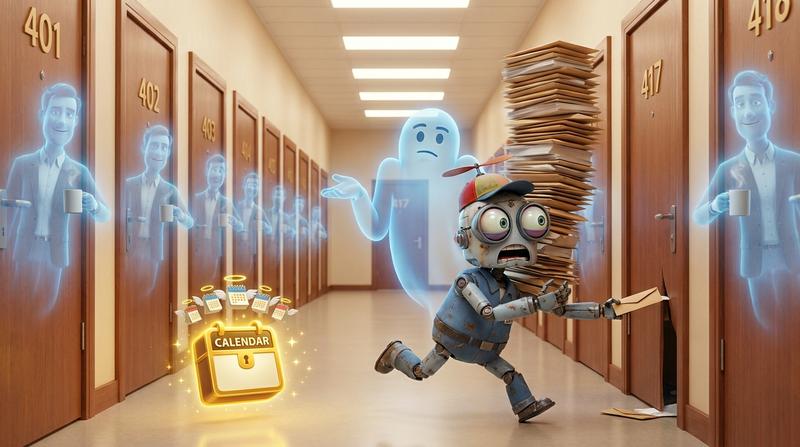
- The median webinar registration-to-attendance rate sits at just 41.6%. That means more than half your registrants are ghosts.
- A calendar save functions as an "implementation intention" - a behavioral commitment that triples follow-through, according to 30+ years of psychology research.
- Calendar save data is the missing input that turns your blind follow-up sequence into an intelligent, segmented workflow.
- Add to Calendar PRO tracks those saves and feeds the signal back into your automation stack - so your sequence finally knows who's actually coming.
Here's a stat that should make every event organizer uncomfortable: the median registration-to-attendance rate across roughly 12,400 B2B webinars analyzed between Q3 2025 and Q1 2026 is just 41.6%. That means for every 100 people who fill out your form, click "Register," and maybe even reply to your confirmation email - fewer than 42 actually show up.
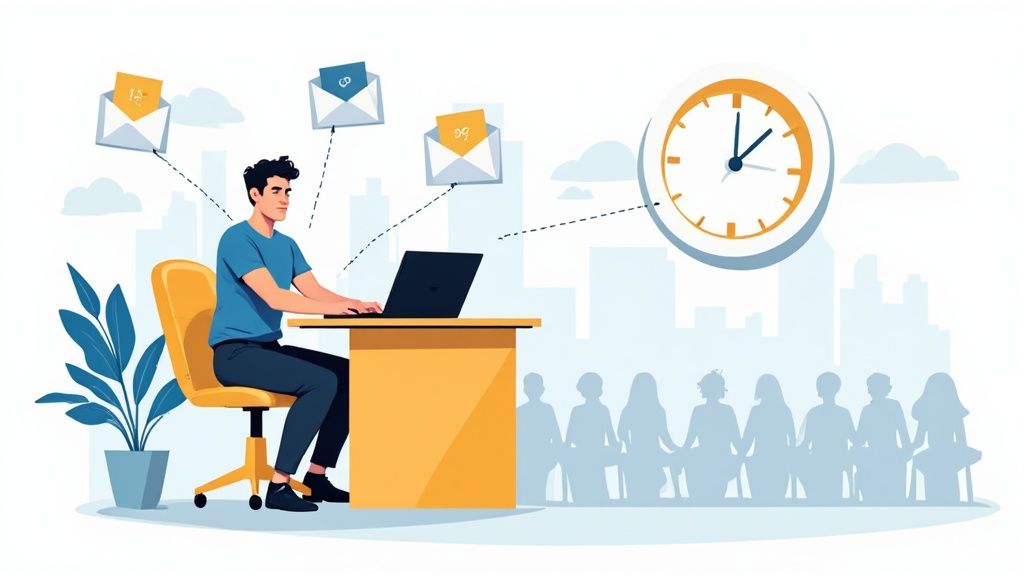
Your follow-up sequence? It's probably doing everything right. Opens, clicks, maybe even a reply or two. But here's the uncomfortable truth: it's flying completely blind. It has zero idea whether any of those registrants actually saved the event to their calendar.
And that gap? That's where no-shows are born.
🎭 Section 1: The Automation Illusion
Most organizers make the same mistake. They confuse a confirmed registration with a committed attendee.
They're not the same thing. Not even close.
Your sequence fires perfectly - drip emails, countdown reminders, maybe a "we're excited to see you!" message the morning of. But it's firing into a void. It doesn't know if the recipient:
- Actually blocked off the time on their Google Calendar
- Saved the date to Outlook so it pops a reminder
- Or - more likely - registered on impulse and hasn't thought about your event since
The difference between "I signed up" and "it's on my calendar" is the differance between maybe and yes.
Here's a rhetorical gut-check for you: When was the last time YOU showed up to something you never blocked off?
Exactly.
"People do not decide their futures. They decide their habits, and their habits decide their futures." - F.M. Alexander
A registration is a decision. A calendar save is a habit trigger. Your automation only sees the first one.
📊 Section 2: Why Calendar Data Changes Everything
Let's talk about what a calendar save actually is - from a behavioral psychology perspective.
Peter Gollwitzer's research on implementation intentions at NYU spans over 30 years. The core finding? People who form specific "when-then" plans - like blocking a time slot on their calendar - complete goals at roughly three times the rate of those who only set a vague intention. A 2024 meta-analysis of 642 independent tests confirmed this with an effect size of d=0.65. That's one of the most robustly replicated effects in all of behavioral psychology.
So when someone saves your event to their calendar, they're not just doing you a favor. They're creating a neurological commitment device. The calendar slot becomes the "when" cue, and attending becomes the pre-decided "then" response. It shifts behavior from deliberate decision-making to something closer to automatic.
That's not a vanity metric. That's a behavioral signal.
But here's the catch:
- Your CRM doesn't track it.
- Your ESP doesn't track it.
- Your Zapier flow doesn't track it.
- Your entire marketing stack is blind to it.
Without calendar save data, your follow-up sequence treats a ghost and a superfan identically. Same emails. Same cadence. Same urgency. It's like a doctor prescribing the same medication to every patient regardless of symptoms.
And let's be honest about another thing your sequence is probably relying on: open rates.
Apple's Mail Privacy Protection now affects roughly 58% of all email opens globally, inflating reported open rates by 15-35%. More than half of your "opens" might be machine-generated noise. So if your automation is using opens as a signal that someone is engaged? It's learning from false data.
Calendar saves don't have that problem. A calendar save requires deliberate human action. It's un-fakeable.
| Signal | Requires Human Action? | Inflated by Apple MPP? | Predicts Attendance? |
|---|---|---|---|
| Email Open | ❌ No (machine-generated) | ✅ Yes (15-35% inflation) | ❌ Weak |
| Email Click | ✅ Yes | ❌ No | ⚠️ Moderate |
| Registration | ✅ Yes | ❌ No | ⚠️ Moderate |
| Calendar Save | ✅ Yes | ❌ No | ✅ Strong |
The calendar save is the most honest engagement signal in your entire funnel. And you're probaly not tracking it.
🛠️ Section 3: What Follow-Up Automation With Calendar Data Actually Looks Like
Ok, so what does this look like in practice? Not theoretically. Practically.
Imagine your follow-up sequence has one new data point: did this person save the event to their calendar?
Now you can do things like:
- Trigger different reminder sequences based on save status. Someone who saved the event gets a lighter touch - a quick "see you tomorrow!" instead of five escalating urgency emails.
- Suppress "last chance" urgency emails to people who already blocked the date. They don't need convincing. They need logistics - a link, an agenda, a parking map.
- Double down on non-savers. These are your at-risk registrants. Hit them with a "Don't forget to add this to your calendar" nudge. Re-engage them with value propositions. Give them a reason to commit.
- Use save-rate as a predictive metric for seat fill - before the event even happens. If your save rate is 30% but you need 80% attendance? You know two weeks out that you have a problem. You can act on it.
This isn't a fantasy workflow. It's a calendar saves as a predictive signal for event attendance approach that segments registrants into high-intent (saved) and low-intent (not saved) groups in real time.
And it starts with one thing: a calendar button that actually reports back.
"Without data, you're just another person with an opinion." - W. Edwards Deming
Your follow-up sequence has been operating on opinions. It's time to give it data.
🔗 Section 4: The Missing Node in Your Stack
Let's be real for a second. Most event confirmation emails include a calendar link. Maybe it's a raw .ics file download. Maybe it's a "Add to Google Calendar" link someone cobbled together from a URL generator.
But here's what those approaches have in common: they're dead ends. The user clicks, maybe the event lands in their calendar, and... that's it. No signal comes back. No data flows into your automation. It's a one-way street.
This is the missing calendar node in your automation. Your Zapier flows move data perfectly between forms, CRMs, and email platforms. But none of them know whether the human on the other end actually saved the date.
Add to Calendar PRO changes that equation.
Here's how it works:
- You embed the Add to Calendar PRO button in your confirmation page or email.
- When a registrant clicks it and saves the event, that action is tracked.
- The save signal feeds back into your automation via webhook or integration.
- Your follow-up sequence now knows who committed and who didn't.
One integration. One data point. But it rewires how your entire follow-up behaves.
And it addresses the commitment gap between registration and attendance - that psychological space where registrants lose motivation, forget, or just... don't show up. The one-click calendar save creates the micro-commitment that closes that gap.
Old Way vs. New Way
| Aspect | ❌ Without Calendar Data | ✅ With Calendar Data (Add to Calendar PRO) |
|---|---|---|
| Follow-up strategy | One-size-fits-all drip | Segmented by save status |
| Urgency emails | Sent to everyone (annoying superfans) | Targeted to non-savers only |
| Attendance prediction | Guesswork based on reg numbers | Predictive metric based on save rate |
| Day-of reminders | Generic blast | Personalized by commitment level |
| No-show mitigation | Reactive (post-event analysis) | Proactive (two weeks before) |
| Engagement signal quality | Inflated opens, unreliable | Clean, human-action-only data |
🎯 Conclusion: Your Automation Isn't Broken. It's Just Missing One Input.
Let's not overcomplicate this.
Your follow-up sequence is probably well-built. Your emails are well-written. Your timing is dialed in. You might even have a solid day-of reminder strategy - which, according to ON24's data, drives roughly 38% of total live attendance.
But all of that automation is running without the one piece of data that tells you whether someone is actualy coming.
Calendar save data isn't a nice-to-have. It's the missing input that transforms your sequence from a broadcast tool into an intelligence system.
Feed it that signal - and your automation stops guessing.
It starts knowing.
And that's the difference between a 41.6% attendance rate... and something significanlty better. 🚀